
The Reality of Running a Cloud Kitchen Nobody Talks About
Thinking of starting a cloud kitchen? Before you invest your time and money, read about my real experience—from setting up the kitchen and getting our first orders to managing staff, unexpected expenses, losses and eventually shutting it down.
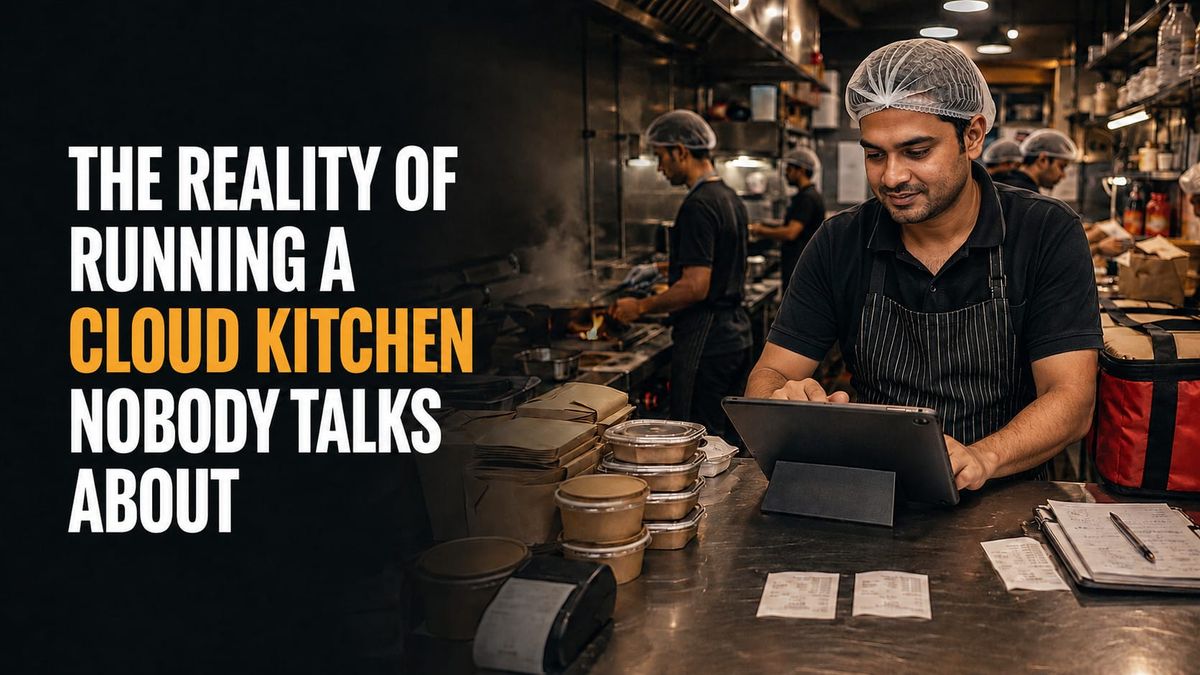
These days, I meet many people who want to start a cloud kitchen. Some want to do it as a side business while continuing their jobs.
And when you search online about how to start a cloud kitchen—or even talk to someone about starting one—you automatically start seeing advertisements on your phone. These advertisements can make the idea look very attractive. Sometimes, you get so motivated that you start thinking about it seriously and researching more and more.
At the same time, there is another thought that often comes into your mind:
What will people think about me?
What will my friends and family say if I start a small food business?
So, I want to share my real and personal experience of running a cloud kitchen.
Before I start, I want to make one thing clear: this is my personal experience. You can take ideas from it, but make your own decision after understanding your situation, budget and capabilities.
Why Do People Want to Start a Cloud Kitchen?
One of the biggest reasons is that people believe a cloud kitchen does not require a lot of investment.
The delivery trend also makes the business look easier and more profitable. Today, many people prefer ordering food at home, so it seems like there is a good opportunity in the market.
Around two years ago, my husband told me that one of his friends wanted to start a cloud kitchen. He was leaving his job and wanted to start something of his own.
My husband told me that his friend was looking for financial support and wanted us to invest in the business.
I agreed.
And that's how our journey started.
Starting From Scratch
We started working on everything together.
We had to finalise the name, complete the documentation, find a place for the kitchen, arrange staff, buy utensils, purchase ration and manage many other things.
Initially, we decided to sell only biryani.
We planned to offer both Lucknowi and Hyderabadi biryani in different varieties.
We found a place for the kitchen and hired a chef who specialised in biryani. We also selected our packaging and put our brand name on it.
The chef was a good cook, although it took us some time to completely trust his cooking.
We tried our best to prepare the food according to the taste and quality we wanted.
At that time, we had very limited staff, so we divided the responsibilities.
One person would support the chef in the kitchen or help with deliveries.
I handled social media and other management work.
My husband continued working at his job while investing in and supporting the business on the side.
The Kitchen Was Cheap, But the Business Wasn't
The kitchen space was quite affordable.
Of course, it was only a delivery kitchen. There was no seating arrangement for customers.
We completed our documentation, including FSSAI and partnership-related documents.
Then came another major step: getting our brand listed on well-known food delivery platforms.
There were many formalities involved.
We had to arrange food photoshoots, upload documents, provide information about the restaurant and complete several other requirements.
After getting our brand listed on these platforms, it took around 25–30 days before we started receiving orders.
That's when we understood another important part of the business.
Food delivery platforms take a significant percentage from each order.
In our experience, it was around 15–30%, depending on the platform and other factors.
Now think about it.
You have your food cost, packaging cost, staff expenses, rent, electricity and other operational expenses—and then a percentage of your order value also goes to the platform.
So, where does your profit come from?
Increasing Prices Isn't Always Easy
One obvious solution is to increase the price of your food.
But that doesn't always work.
Especially when you are a new brand, customers are comparing your prices with other restaurants. If your food is priced much higher, a first-time customer may think twice before ordering from you.
So we started focusing on building our own customer base.
We distributed pamphlets.
We created social media accounts and started posting engaging content.
And yes, we started getting some customers through social media as well.
But there was another thing we slowly realised.
You cannot easily manage a full-time job and a growing food business together.
A cloud kitchen may not have a dining area, but that doesn't mean it requires less work.
Our kitchen was operating in both shifts—morning and late night.
Eventually, because of the circumstances, I had to leave my job.
The business was also doing well at that time, so I decided to give it my full attention.
Learning Through Experience
We started receiving all kinds of customer feedback—both good and bad.
We tried to learn from it.
One thing we quickly understood was the importance of standardising the food.
Your staff may not always remain the same.
Different people can cook the same dish differently.
And customers don't care who is cooking. They expect the same taste every time they order from your brand.
This was something we had never learned from anyone.
It was our first experience.
We were learning everything through our own mistakes and experiences.
We worked on food quality, packaging and service.
And we invested a lot of money in these things.
At that time, we weren't sitting and calculating every rupee we were spending. We were simply trying to make the business work.
But later, we realised something important:
When you prepare a budget, prepare for the expenses you don't expect as well.
You may think, "I won't spend too much."
But once the business starts, small expenses keep adding up.
And eventually, the amount can become much bigger than you expected.
Things Were Finally Going Well
Eventually, things started getting better.
We were receiving good orders.
We weren't making a huge profit, but for a new business in its initial stage, we were getting a decent number of orders.
And I learned another important lesson:
In the beginning, you cannot always focus only on profit.
If the business is moving in the right direction, building customers and creating a good product, profitability can take time.
At least, that's what we experienced.
But then something unexpected happened.
When the Partnership Broke
Some other complications came into the picture, and eventually, our partnership broke.
That was a very difficult period for us.
We had no choice but to shut down the cloud kitchen.
It was heartbreaking.
We had invested our time, money and energy into building it.
But sometimes, business decisions are not completely in your hands.
After around three months, my husband and I decided to start again.
Starting All Over Again
This time, we did everything ourselves.
The name.
The staff search and hiring.
Documentation.
Location finalisation.
Renovation.
Packaging.
Uploading the restaurant on food delivery platforms.
Everything.
We had to start from almost zero again.
And this time, it was even more difficult because my husband was still working.
So, I had to manage most of the work myself.
Again, we invested a considerable amount of money.
This time, we also decided not to limit ourselves to biryani.
We added parathas and other North Indian dishes to our menu.
We worked hard on the new kitchen.
And initially, things went quite well.
Interestingly, we noticed the same pattern again.
We were getting more orders at night compared to the morning.
Weekends were particularly busy.
Sometimes, we would reach home around 3 a.m.
At that time, we had only two staff members.
So I was doing multiple things.
During the day, I worked on our online presence and other management responsibilities.
In the evening, I helped the staff in the kitchen.
For around three months, things were going well.
We were getting enough orders that we could at least buy the kitchen ration from the money generated through sales.
It wasn't a huge profit, but the business was moving.
The Biggest Challenge: Staff
Then came one of the biggest challenges we faced:
Managing staff.
Finding good staff is difficult.
Keeping them is even more difficult.
And making sure they maintain the quality and standards you expect is another challenge altogether.
One night, one of our staff members left the kitchen in the middle of the night—around 3:30 a.m.
We weren't there.
My husband was out of station and I was sleeping.
When I found out the next morning, I was shocked.
The kitchen was actually doing quite well at that time.
But suddenly, we had no staff.
Finding someone immediately was extremely difficult.
For some time, the kitchen had to remain closed.
Eventually, after searching for a while, we found new staff.
They started working.
But something had already changed.
Our orders had started going down.
Customers were not getting the same taste and quality they had experienced earlier.
And that's when I decided to cook for the kitchen myself.
Once I started cooking, we began receiving good feedback from customers again.
But the order flow never returned to the level it had reached earlier.
The kitchen had already been closed for some time, and we had lost some momentum.
We tried to manage everything.
But financially, things were not going well.
We were making losses.
And finally, we had to make the decision to close the cloud kitchen.
What Did I Learn?
Closing the business was heartbreaking.
But looking back, I can say that the experience taught me more than any online course or advertisement could have.
I saw the business from every side.
I experienced the excitement of getting our first orders.
I experienced the happiness of receiving good customer feedback.
I experienced the stress of managing staff.
I experienced unexpected expenses.
I experienced the pressure of running a business while managing personal responsibilities.
And I also experienced what it feels like to lose something you worked very hard to build.
If you are thinking about starting a cloud kitchen because it looks like an easy side business, I would suggest you think about it carefully.
A cloud kitchen may not require a restaurant dining space, but it is still a full business.
It requires time.
It requires money.
It requires people.
It requires consistency.
And most importantly, it requires you to be prepared for things that you didn't plan for.
My experience had many ups and downs.
But I don't regret it.
Because I learned something from every stage.
And sometimes, the experience you gain from a failed business is worth more than the profit you expected to make.