The World of Pottery: What Happens Before Clay Becomes a Pot, Diya or Matka?
From clay to everyday utensils, pottery is a craft shaped by skill, tradition and generations of knowledge. Meet a potter who has worked with clay since 1965 and discover how this timeless craft is adapting to a changing world.
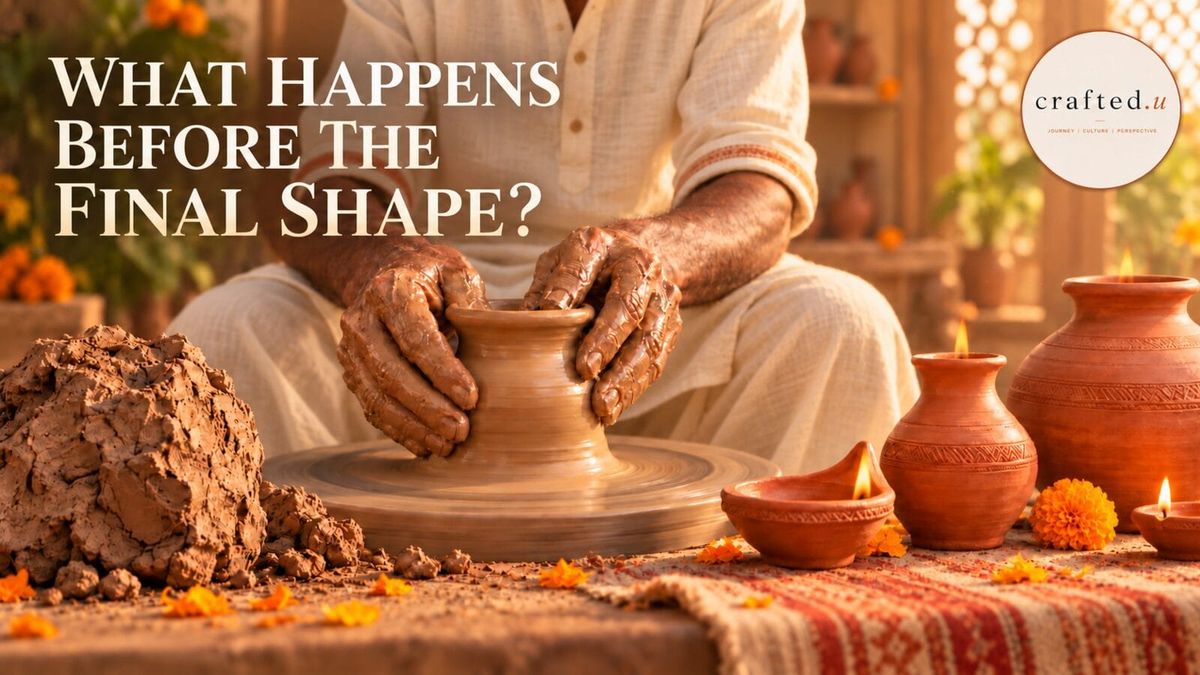
The taste of kulhad wali chai is different. Most of us have experienced it at some point. But it’s not just tea that attracts us to food served in clay utensils.
Whether it’s kulfi served in a clay bowl, handi biryani, or lassi in a clay glass, somehow everything feels a little different.
Clay is also closely connected with many Indian festivals and traditions. During Diwali, we light mitti ke diye. Eco-friendly Ganpati idols are becoming increasingly popular, and during Karwa Chauth, the traditional karva is an important part of the ritual.
Beyond festivals, many people still use clay pots to store drinking water. Some also prefer cooking in earthen pots.
In one way or another, we have always had a connection with clay.
But have we ever stopped to think about how these things are made, who makes them, and what kind of clay goes into making them?
We decided to find some of these answers.
Our search took us to Kumhar Gram in Delhi, one of the city's well-known pottery communities. Around 700–800 potter families live here, many of them with roots in Rajasthan.
Our first impression of the place was that it was busy and quite congested. Finding a place to park a car can be difficult. But as soon as we entered the area, pottery shops and workshops started appearing along the narrow lanes.
We met several people along the way. Despite being busy with their work, many of them were willing to stop and talk to us. For someone working on a deadline or managing their daily orders, taking the time to speak with a stranger is not a small thing.
During our visit, we also met an experienced potter who has spent decades working with clay.
He had learned the craft from his father and has witnessed the profession change over the years — from preparing clay and operating the wheel by hand to using machines that have made several parts of the process easier.
So, what actually goes into making a clay pot?
What kind of clay do potters use?
How has this traditional profession changed?
And with changing markets and modern alternatives, how does a pottery family continue to make a living from this craft?
Here is what he told us.
It All Starts With the Clay
Before pottery takes shape on the wheel, the clay itself has to be prepared.
The artisan explains that they mainly use two types of clay — black and yellow. Black clay is used in a larger proportion, while yellow clay is added in a smaller quantity.
The preparation is not a quick process. The clay needs to be processed, mixed and kneaded before it becomes suitable for making pottery. According to him, preparing the clay can take around four to five hours.
Earlier, this work was done manually. Potters used their hands and feet to process the clay. Today, machines have taken over much of the physically demanding work.
But machinery has not removed the need for experience.
A potter still needs to understand the material — its consistency, texture and how it responds while being shaped.
From Hand-Powered Wheels to Machines
The tools used in pottery have changed considerably over the years.
The artisan remembers working with a manually operated wheel. Today, electric wheels and machines have made several stages of production easier and faster.
Clay-grinding machines have also reduced some of the physical labour involved in preparing the material.
For someone who has been part of the craft for decades, these changes reflect how traditional pottery has adapted to modern times.
The technology may be different, but the knowledge of working with clay remains essential.
Learning From a Father
He has been connected with pottery since 1965.
When he started, he made the same kinds of products his father had made.
These included everyday household vessels used for cooking, heating milk and storing water. With time, his work expanded to other products, including matkas and vessels used by food vendors.
His experience reflects how traditional crafts are often learned — not through a classroom, but by watching an older generation work and gradually learning through practice.
The skill becomes part of the family before it becomes a profession.
Why Clay Still Matters
For the potter, clay is not just the raw material he works with every day. He sees it as something deeply connected to our lives.
Clay has been part of Indian traditions for generations. We see it during festivals, in our homes and in everyday practices — from diyas and kalash to matkas and cooking vessels.
He believes that clay has qualities that make it special. For him, its natural character is what sets it apart from materials such as plastic or metal.
For him, clay’s natural character is what makes it special. Once shaped and fired, it becomes something useful and durable.
For him, even the sound of a finished earthen pot can reveal something about its quality. An experienced potter can tap a vessel and listen to its sound to understand whether it has been properly fired and whether it is a good piece.
His connection with clay is therefore not only professional. After spending decades working with it, he understands its texture, behaviour and different stages in a way that comes only through years of experience.
And perhaps that is why, when he talks about pottery, he doesn't speak about clay as simply a material.
He speaks about it as something that has been part of people's lives for generations — and something worth preserving.
Pottery Has Its Own Season
For pottery families, the year is closely connected with demand.
Summer brings greater demand for matkas and vessels used for storing water. Then the festival season brings another kind of work.
Ganesh Chaturthi, Navratri, Karva Chauth and Diwali create demand for products such as diyas, kalash, idols and other decorative and traditional items.
The artisan describes the period around Diwali as an especially important season for their work, lasting around two to two-and-a-half months.
But once the season ends, demand slows down.
This makes pottery a seasonal livelihood where artisans have to plan their production around festivals, weather and the market.
When Weather Becomes Part of the Job
Clay needs to be handled carefully.
The artisans keep their raw material protected from rain by storing it indoors or covering it with plastic sheets and tarpaulin.
The finished pieces also need time to dry before they can be fired.
A sudden spell of rain can therefore affect the entire process.
For a potter, weather is not something separate from the work. It can determine how quickly the clay dries, when pieces can be fired and how much production is possible.
From the Workshop to Different Markets
The pottery made by the artisan does not remain limited to the local area.
His products reach markets in places such as Chandigarh, Ludhiana, Moga and Amritsar.
But selling pottery today is different from selling it in the past.
People now have access to plastic, steel and mass-produced alternatives that are often cheaper, more convenient and widely available.
This has changed the demand for traditional earthen products.
Some items that were once common household necessities are now purchased mainly for specific purposes, occasions or festivals.
A Heritage That Keeps Evolving
For this family, pottery has continued across generations.
The potter learned the craft from his father, and today, his sons are also involved in the same business. What started with his father has now become a family profession that the next generation is carrying forward.
But his family is also an example of how the pottery community is adapting with time. The younger generation is not simply following the old ways; they are bringing their own ideas and creativity into the craft.
His granddaughter, for instance, creates new designs and experiments with different forms. She uses her own ideas to create pieces that are different from the traditional products the older generation made.
For him, this is a positive change. The craft can evolve with changing times while still keeping its roots intact.
The tools have changed, machines have made some parts of the work easier, designs are evolving, and the market looks different from what it did decades ago. But the skill and knowledge continue to move from one generation to the next.
For him, pottery is not simply a business.
“Ye toh hamari dharohar hai, isse toh sambhal kar rakhna hoga.”
It is something he learned from his father, built his life around, and is now watching his sons continue. His family itself is an example of how a traditional craft can be preserved while also adapting to a changing world.
A craft that began with one generation is still taking shape in the hands of the next.
Watch the full story of pottery, tradition and changing times.